
Lace nail art is having a visible 2026 moment, but its appeal goes beyond one trend cycle. Pinterest included “Laced Up” in its 2026 trend forecast and reported a 215% rise in searches for “lace nails.” The look can be soft and bridal, dark and gothic, or almost architectural depending on color, scale, and finish.
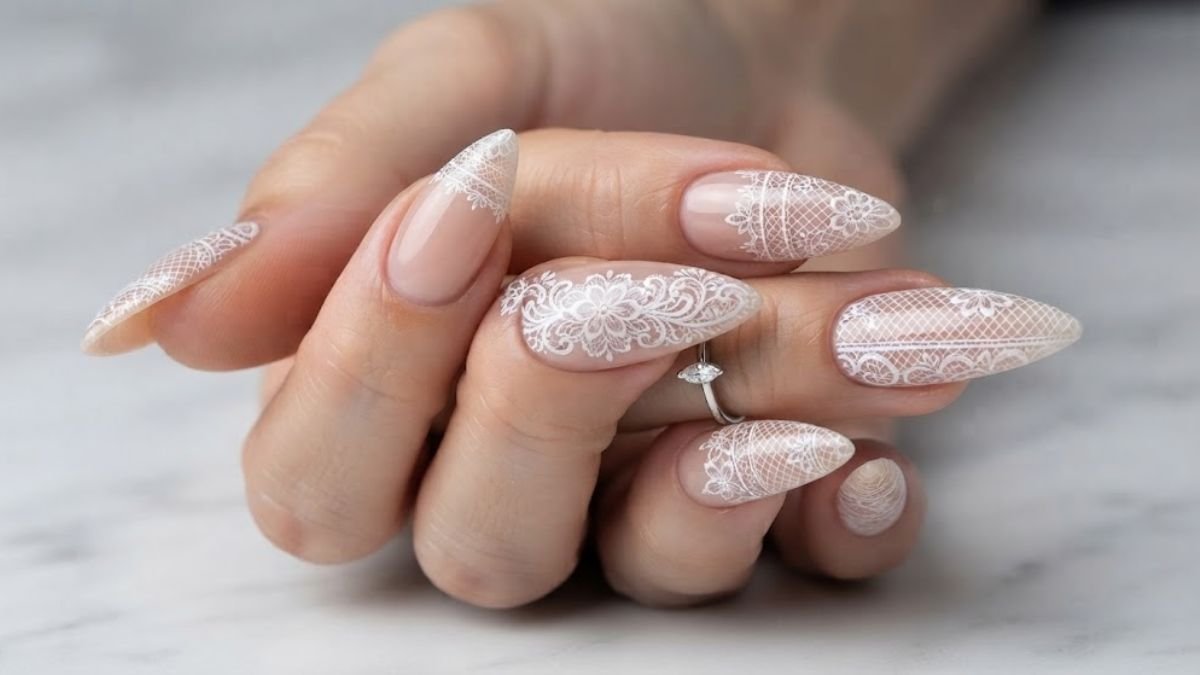
The most convincing versions treat lace as a pattern language rather than a single motif. Fine mesh, scallops, floral repeats, negative space, pearls, and metallic linework can all create the effect. Glamour notes that lace effects can be created with hand-painting, stamping, stickers, or press-ons, which makes the idea adaptable to different skill levels and budgets.
A Quick Guide to Choosing a Lace Nail Technique
| Technique | Best For | What It Does Well | Consider |
|---|---|---|---|
| Stamping | Fine repeating lace | Creates crisp mesh and floral detail quickly | Needs opaque stamping polish and clean transfer |
| Hand-painting | Custom motifs and asymmetry | Lets a nail artist control line weight and placement | Fine lace takes time and a steady detail brush |
| Decals or wraps | Beginner-friendly sets | Provides complex detail without drawing every line | Edges need careful sealing to avoid lifting |
| 3D gel or appliqué | Bows, raised florals, textile effects | Adds real dimension and texture | Best kept away from snag-prone edges |
| Press-ons | Fast temporary wear | Offers intricate lace without a salon appointment | Fit and sizing determine how natural the result looks |
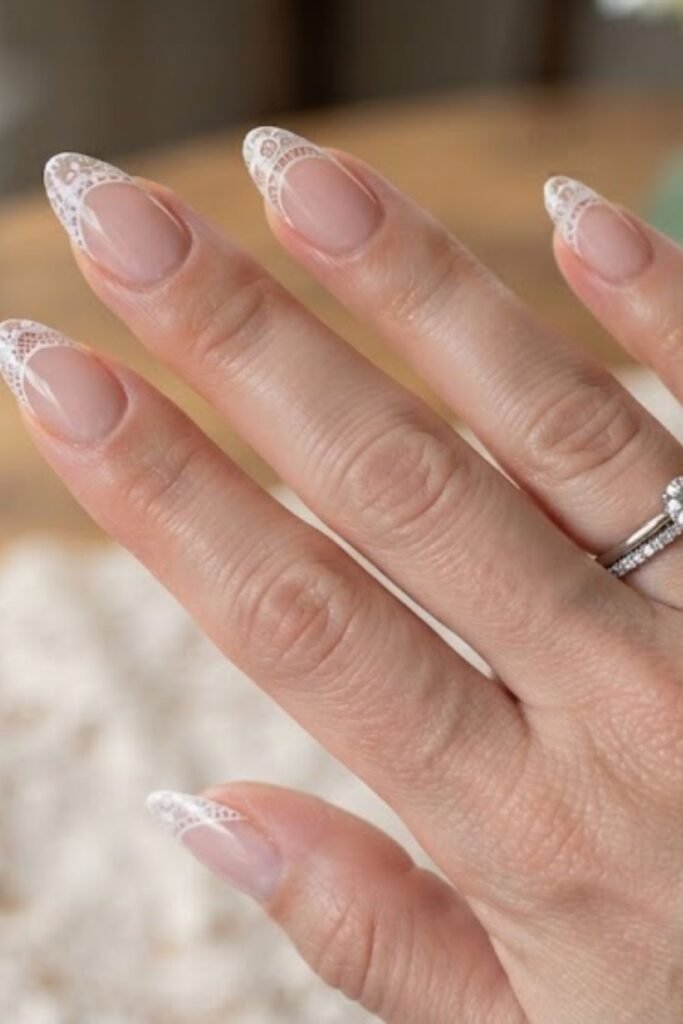
1. White Lace French Tips
Best for: short-to-medium oval or almond nails; bridal, formal, or minimal manicures
Replacing a solid French band with tiny scallops and floral mesh keeps the familiar nude-and-white structure but makes the free edge look lighter. A narrow lace tip works especially well when you want detail without covering the whole nail.
Almond and oval shapes give the pattern enough curve to breathe. If you are deciding on shape first, Redounds’ almond-shaped nail ideas show how tapered tips change the balance of surface art.
2. Black Lace Over a Nude Base
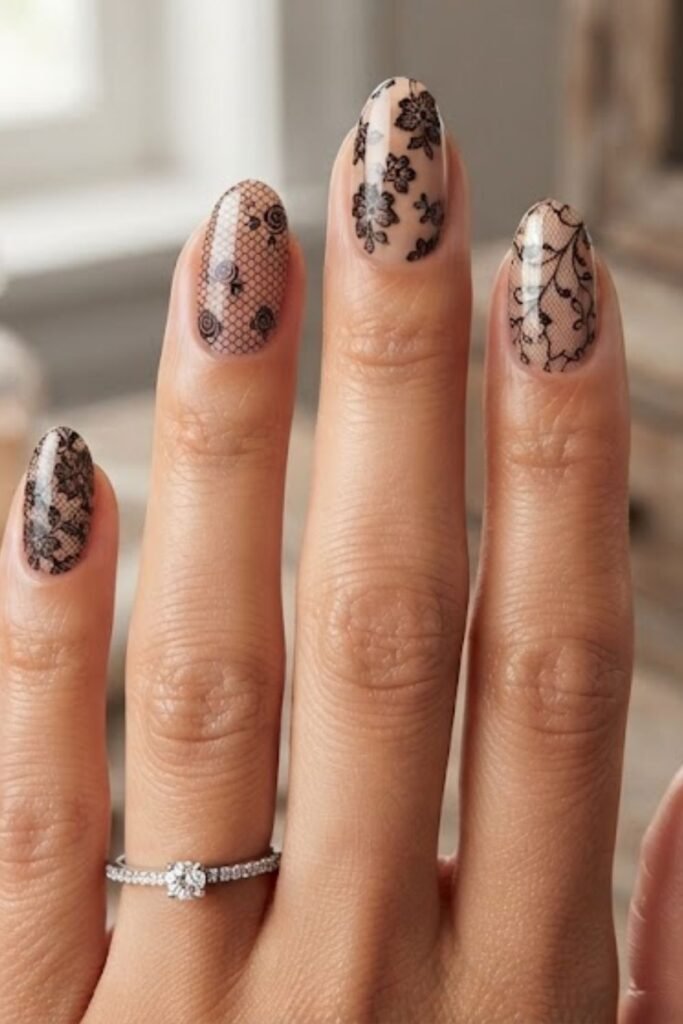
Best for: medium almond, coffin, or oval nails when you want the lace itself to be the focal point
Black lace becomes graphic when it sits over a sheer nude or skin-toned base. The contrast exposes every tiny line, so the pattern should be clean rather than excessively dense.
A glossy finish makes the black look ink-like; a matte version feels softer and more fabric-like. For a darker finish comparison, see Redounds’ black matte nail designs.
3. Sheer White Lace Overlay
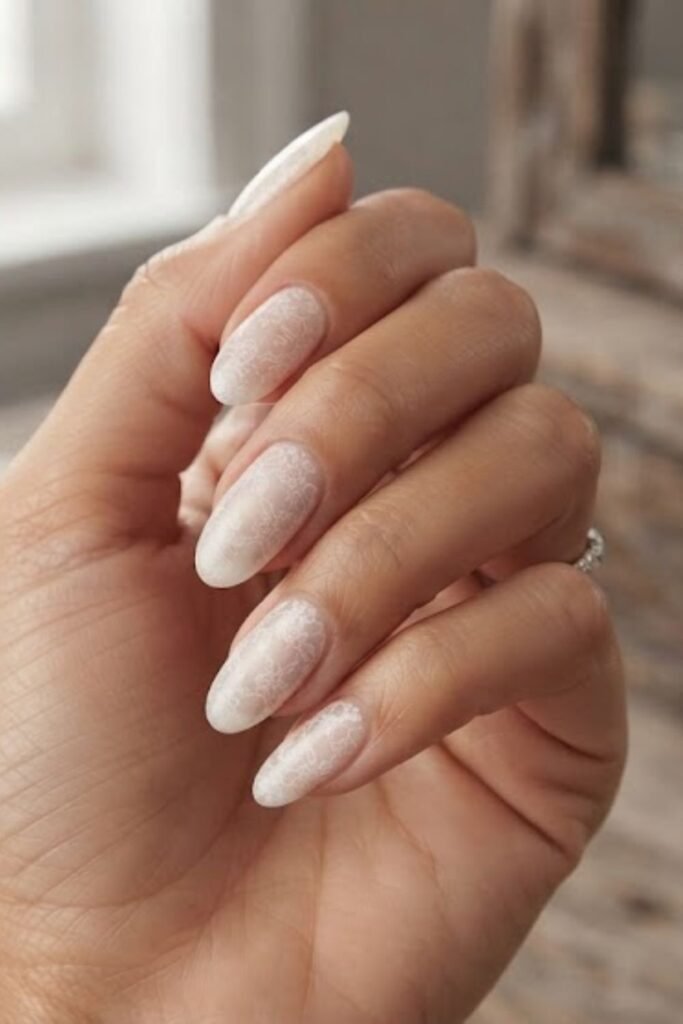
Best for: short or medium natural nails and low-contrast everyday nail art
This is the quietest interpretation: a clear, milky, or barely pink base with fine white lace that appears only when the light catches it. Leaving open space around the motif prevents the design from reading as a solid white manicure.
It is also one of the easiest lace looks to adapt to shorter nails. Use smaller motifs and let natural nail show between them rather than shrinking a full, complicated pattern into a cramped space.
4. Bridal Lace With Pearl Accents
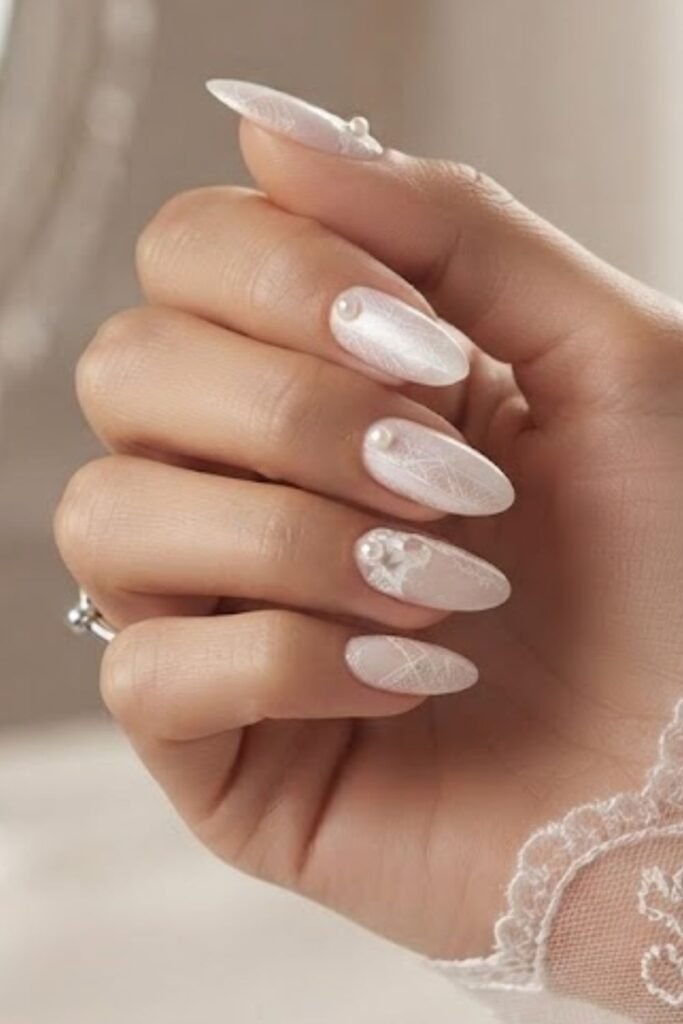
Best for: weddings, engagement photos, and formal events where texture matters more than strong color
Pearls make sense with lace because both depend on small-scale detail. Place micro pearls at a flower center, along a cuticle curve, or on one accent nail instead of distributing large pearls across every finger.
A milky or pearlescent base photographs cleanly and gives the lace enough contrast without competing with rings or dress details. If the gown itself has lace, the manicure can echo its general scale without copying the fabric literally.
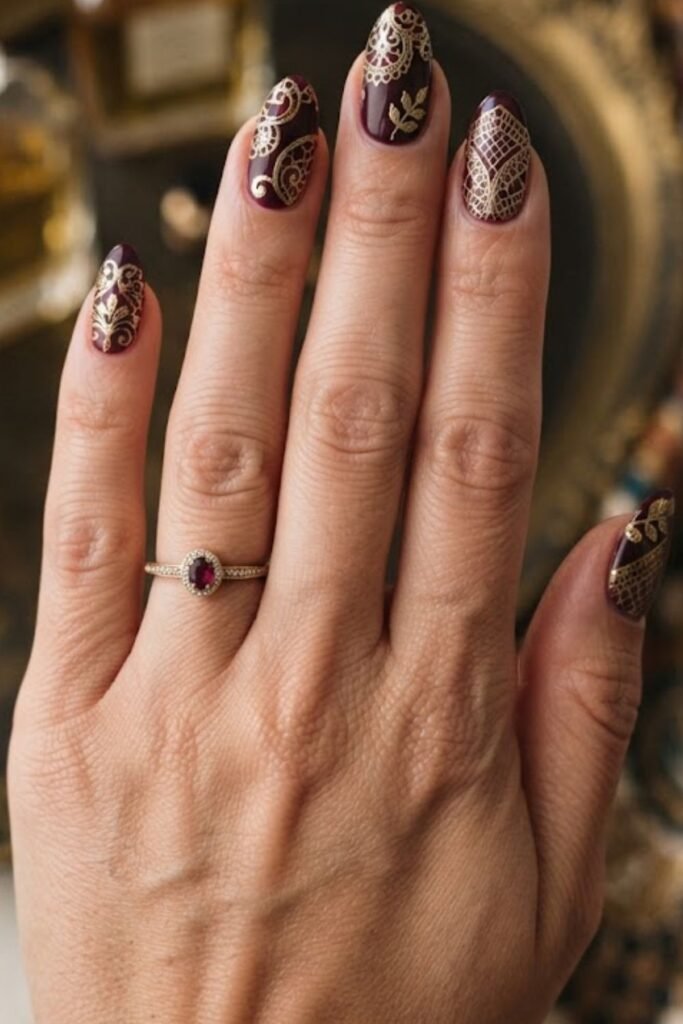
5. Gold Lace on Deep Berry
Best for: medium-to-long nails, evening looks, autumn palettes, and formal dressing
A burgundy, oxblood, or plum base turns lace into evening nail art. Metallic gold linework should stay relatively open so the dark color remains visible between vines, petals, or lattice sections.
The result feels more jewelry-like than bridal. Readers who prefer darker red families can also compare the palette with Redounds’ dark cherry red nail ideas before choosing the base tone.
6. Vintage Ivory Lace Almond Nails
Best for: romantic vintage styling, warm skin undertones, and medium-to-long almond nails
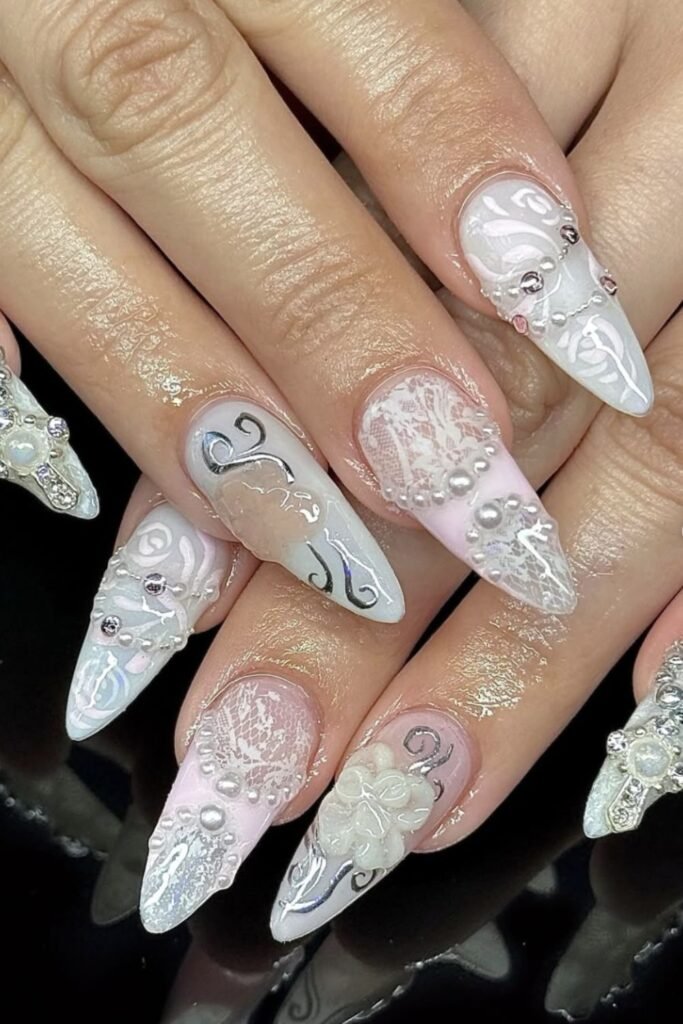
Bright optical white can make vintage-inspired lace feel too crisp. Warm ivory, cream, or antique white creates a softer contrast that resembles aged embroidery and heirloom textiles.
Use scalloped borders and slightly larger floral medallions rather than dense micro-mesh. A soft almond silhouette reinforces the elongated, curved structure of the pattern.
7. Black Lace French Tips
Best for: a gothic-romantic manicure that still keeps visible negative space
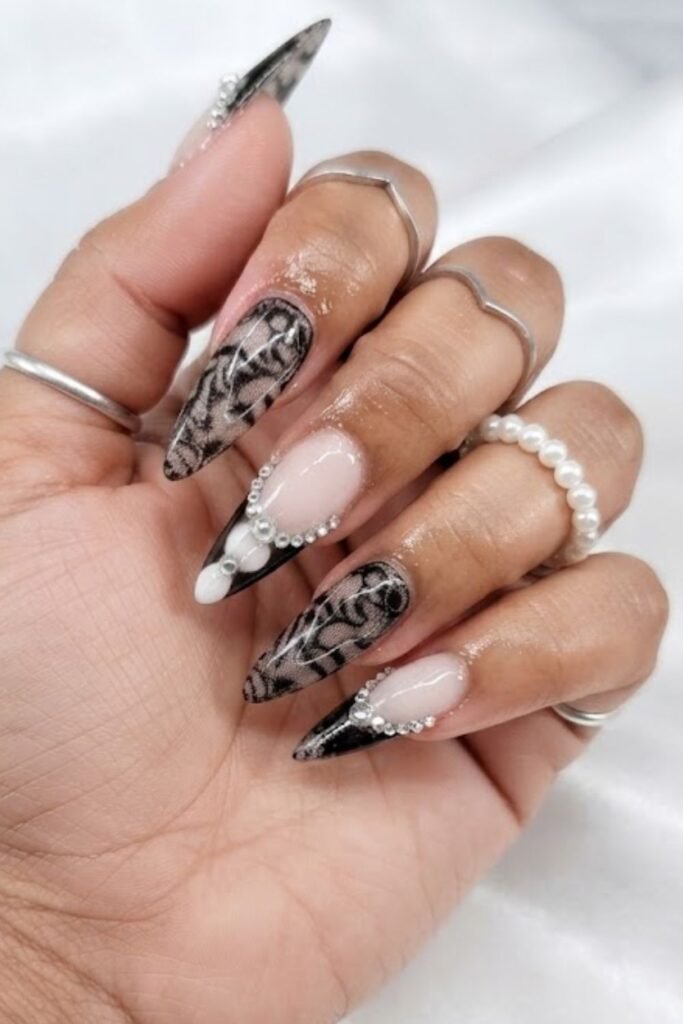
Keeping black lace at the tip gives the manicure a clear boundary, much like a standard French design, but the irregular scalloped edge makes it feel more graphic. The sheer base prevents the black from becoming visually heavy.
On short nails, keep the lace band narrow. On coffin or longer almond nails, the tip can extend deeper without swallowing the nail bed.
8. Blush Ombré With White Lace
Best for: long oval or almond nails and soft bridal or special-event manicures
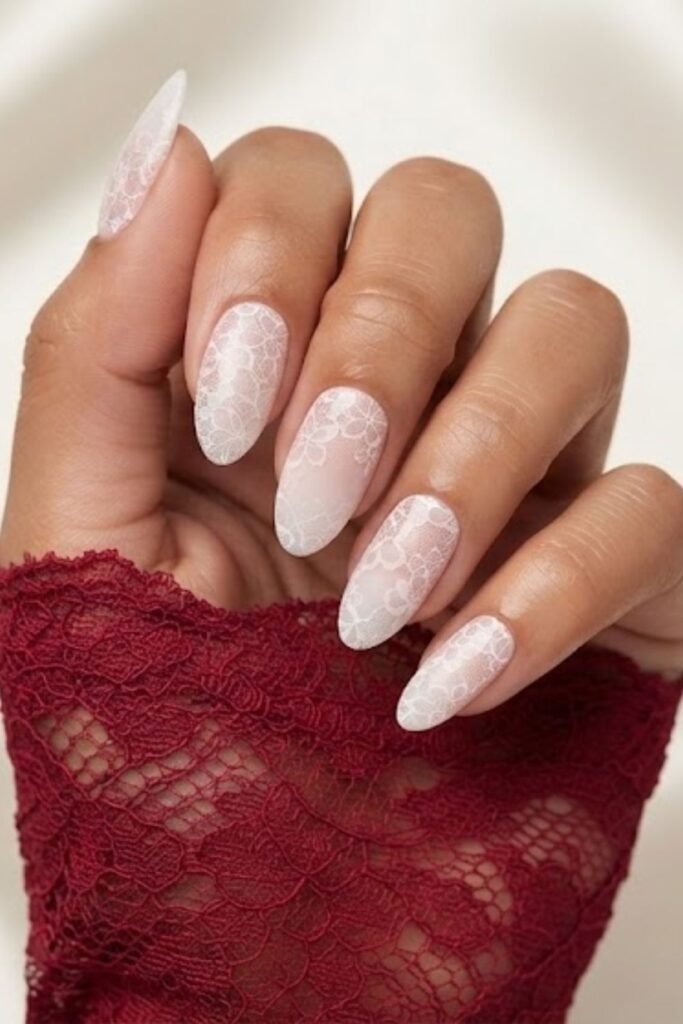
A soft blush-to-milky gradient adds depth behind the lace without introducing a hard color boundary. The background should stay subtle; if the ombré is too saturated, the lace becomes difficult to read.
This is a useful way to make a full lace set feel less flat because the color shifts underneath the repeating pattern rather than competing on top of it.
9. Lace Tips With a 3D Bow
Best for: medium-to-long nails when you want dimensional detail but not a fully embellished set
One small sculpted bow can push lace toward a coquette direction without turning every nail into a charm set. Keep the lace fine and confine the bow to one finger so there is a clear hierarchy.
Placement matters for wearability. A bow near the center or lower third of the nail is generally less exposed than a bulky shape perched at the free edge, where it can catch more easily.
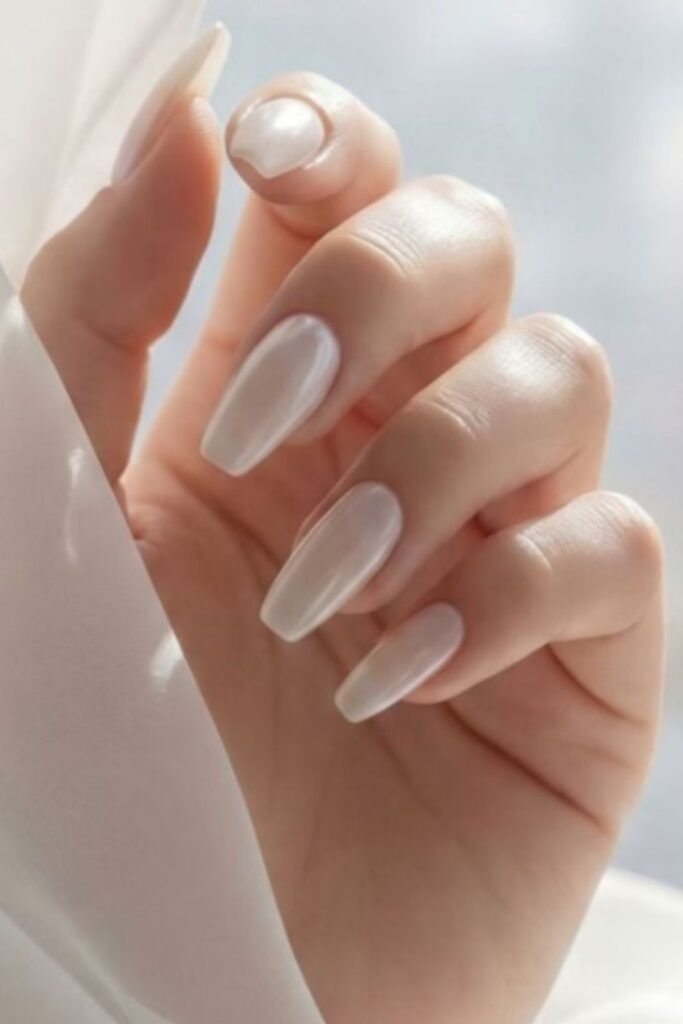
10. Lace With Crystal Accents
Best for: formal manicures, stiletto or almond extensions, and controlled maximalism
Crystals work best when they follow the structure already present in the lace. A tiny stone at a floral center or where two lines intersect looks intentional; random rhinestones can obscure the pattern.
Limit the brightest stones to a few nails and let the remaining lace stay flat. That contrast makes the reflective accents more noticeable without adding unnecessary bulk to every finger.
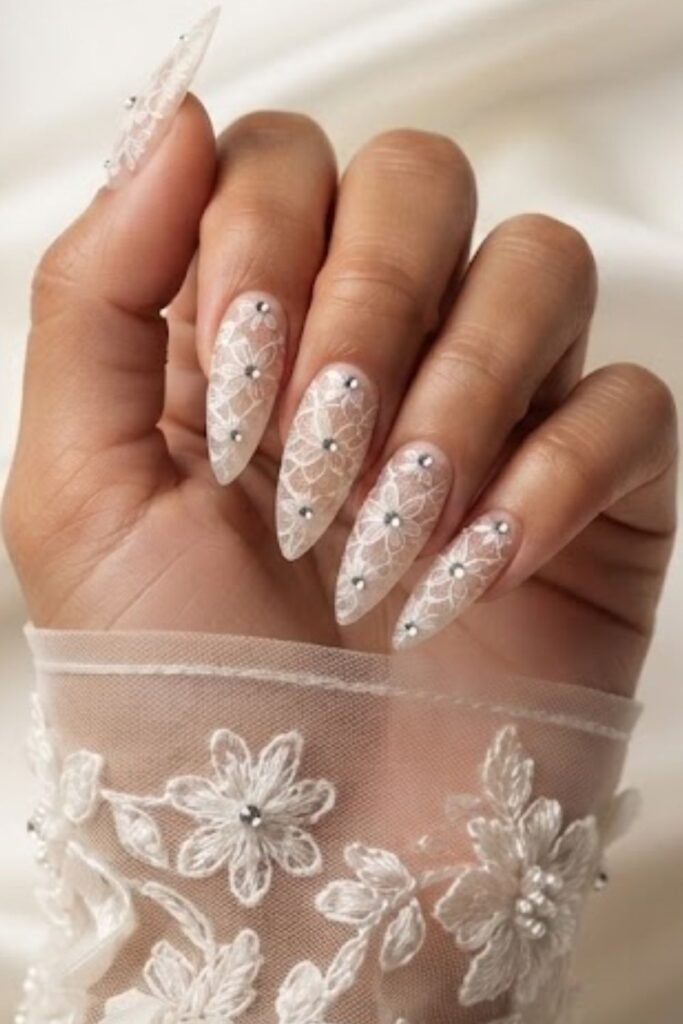
11. Full-Coverage White Lace
Best for: a statement manicure where intricate pattern is more important than embellishment
Covering the entire nail creates the strongest textile illusion. The base should still be visible through the open parts of the pattern, so warm nude, pale blush, or champagne usually gives the lace more definition than an opaque white base.
Because the pattern repeats over the whole plate, scale is important. Fine motifs suit shorter nails; larger floral repeats need more length to avoid looking compressed.
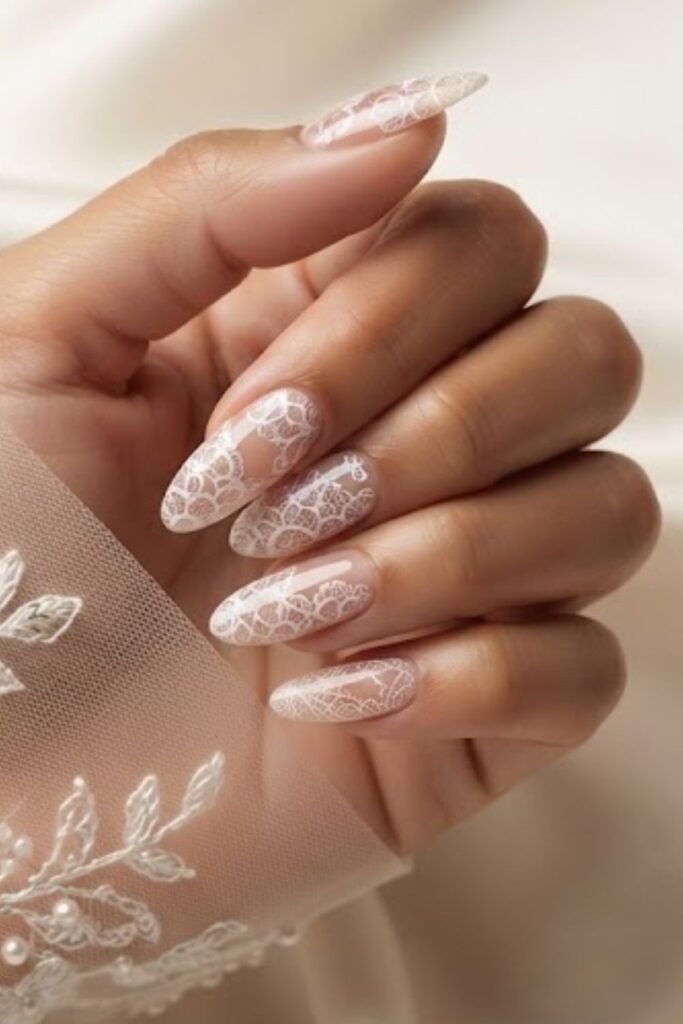
12. Lavender Lace With Micro Pearls
Best for: spring palettes, soft color lovers, and almond nails with enough length for small motifs
Lavender softens the formality of white lace and makes the set feel more playful. A tone-on-tone version, using a lavender base with slightly lighter lavender lace, is subtler than bright white artwork. Redounds’ pastel nail art ideas offer more palette context if you want to move beyond lavender.
A few micro pearls or a faint iridescent glaze can add dimension while keeping the color story quiet.
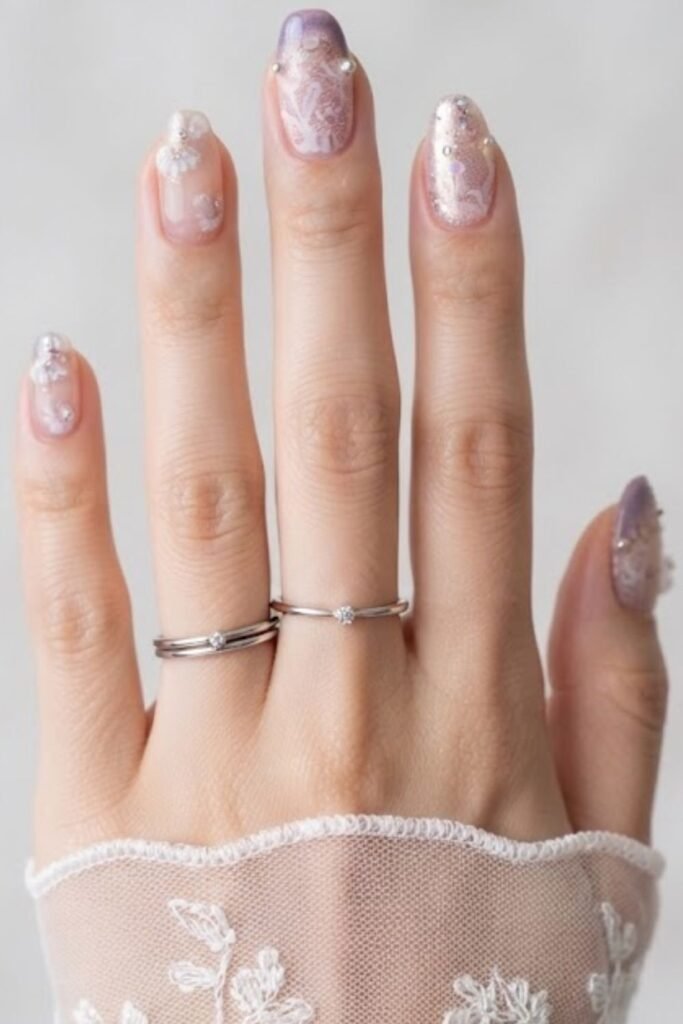
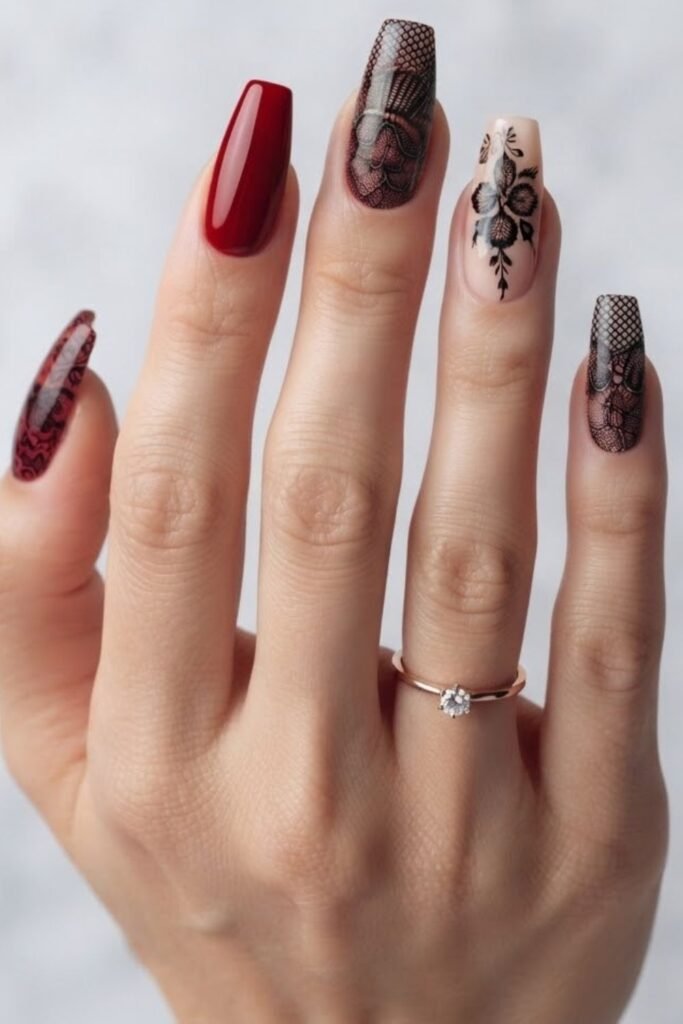
13. Red Lace Overlay
Best for: Valentine styling, evening manicures, and anyone who wants lace with a saturated color rather than white or black
Red lace reads differently from burgundy-and-gold: it is brighter, more graphic, and more romantic. Use it over sheer pink or nude so the red linework stays distinct. Redounds already includes a lace red overlay within its broader red-nail guide, so this version keeps the focus specifically on pattern scale and negative space.
For a balanced set, alternate full lace nails with simpler red tips or sheer nails. That gives the eye somewhere to rest.
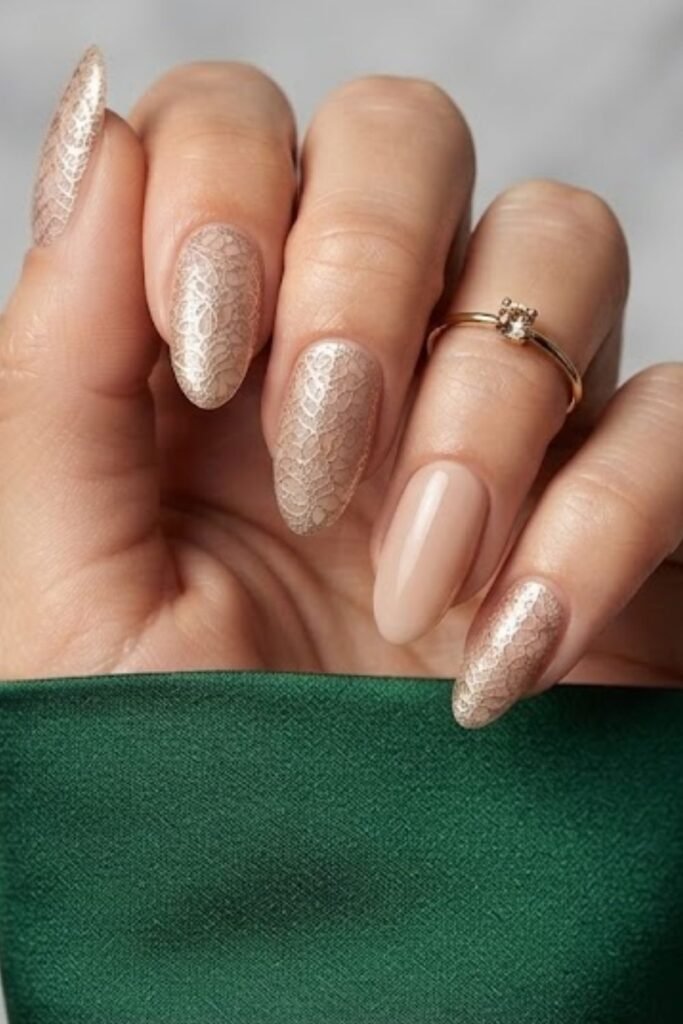
14. Metallic Lace on Nude
Best for: party nails, formal events, and readers who like metallic finishes without full chrome coverage
Champagne gold, silver, or rose-gold stamping changes lace from soft textile to reflective ornament. On a nude base, the effect can stay light while still catching movement. For a darker contrast option, Redounds’ black and gold nail ideas show how metallic detail behaves against black.
Fine metallic stamping usually reads cleaner than large foil patches for this style because the open lace lines need to remain visible.
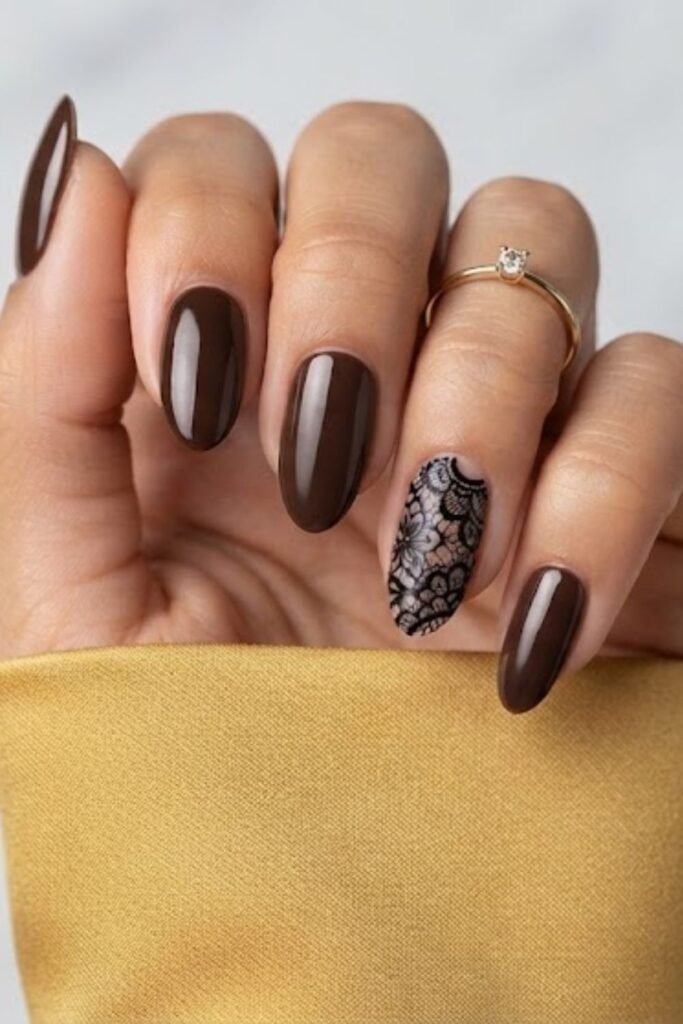
15. A Single Lace Accent Nail
Best for: shorter appointments, first-time lace manicures, or minimalist sets that still need one detailed focal point
One lace nail among solid-color fingers is the most practical way to use an intricate pattern. It gives the artwork enough visual space to be appreciated and lowers the amount of detail that needs to be executed perfectly.
Match the solid nails to either the lace color or the base color. A chocolate set with white lace, black nails with a nude lace accent, or milky nails with one pearl-lace finger can all feel cohesive without repeating the pattern ten times.
Before You Choose Your Lace Set
Decide first how much detail your nail length can carry. Short nails generally benefit from lace confined to a tip, corner, or single accent nail, while longer almond, coffin, and stiletto shapes can support full repeats and layered embellishment.
Then choose the application method. Stamping is efficient for repeating detail, hand-painting gives the most control, and decals or press-ons simplify intricate designs at home. Keep raised bows, pearls, and crystals proportionate to the nail so the surface remains wearable.
Frequently Asked Questions
Are lace nails still trending in 2026?
Yes. Pinterest’s 2026 “Laced Up” forecast reported searches for “lace nails” up 215%, making lace a documented trend signal this year. The design also works beyond the trend because it can be adapted through color, finish, and scale.
Can lace nail art work on short nails?
Yes. Use micro-lace, a narrow French tip, corner placement, or one accent nail. Smaller areas keep the pattern readable instead of compressing a large floral repeat onto a short nail plate.
What nail shape is best for lace designs?
Almond and oval shapes give curved lace motifs room to flow, but square and squoval nails also work well for compact French tips and geometric mesh. The pattern scale matters more than choosing one “correct” shape.
What is the easiest way to create lace nails at home?
Lace decals, nail wraps, press-ons, and stamping plates are easier than freehand painting. Stamping is especially useful for repeating mesh because it transfers many fine lines at once when used with opaque stamping polish.
Can I combine lace nails with a French manicure?
Yes. Lace can replace the solid French tip, sit directly above a classic tip, or appear on one accent nail while the remaining fingers use a standard French design.
Do lace nails have to be white?
No. Black, red, burgundy, lavender, brown, metallic gold, and silver can all create lace effects. White reads softer and more bridal; darker colors increase contrast, while metallics make the design feel more ornamental.
Are 3D lace nails practical for everyday wear?
They can be, but flatter versions are easier to live with. Raised bows, pearls, crystals, or fabric appliqués may catch on hair and clothing, so keep dimensional details small and place them away from exposed edges.
What should I ask for at the salon?
Bring a reference image and specify the base color, lace color, motif scale, nail shape, finish, and how many nails should carry the pattern. Also say whether you want stamped, hand-painted, decal, or raised 3D detail.
Choosing Your Version
The strongest lace manicure is not necessarily the most detailed one. A narrow scalloped French tip can communicate the idea as clearly as a full-coverage floral set if the scale suits the nail. Start with the mood you want—soft, gothic, vintage, colorful, or metallic—then choose a technique that fits your length and tolerance for maintenance. Lace works best when the pattern remains visible, intentional, and proportionate.