
Black and white Halloween makeup occupies a specific register that full-color special effects makeup does not. It is not a face painting exercise. At its best it is a graphic, high-contrast makeup approach that uses the absence of color as a design decision. The white blank, the precise black line, the shadow at the hollow of the eye, these are choices that read as considered rather than assembled.
These 10 looks cover the range from minimal and modern to fully theatrical, across face paint-free approaches using standard makeup products and looks that incorporate body paint for the most dramatic results. Each one is described specifically enough to execute at home or to brief a makeup artist with a clear direction.
Minimal Black and White Halloween Makeup Looks
Graphic Black Eye with Pale Skin
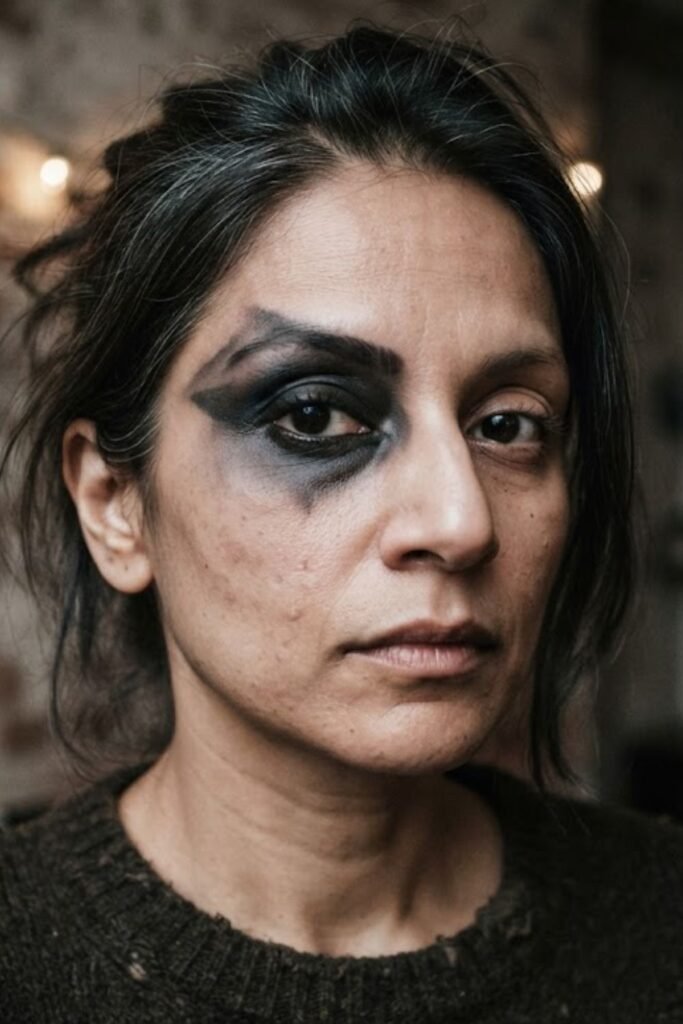
The simplest black and white Halloween makeup is a deliberately graphic black eye against skin that has been made visibly paler than usual with a white-tinted base. No character reference required. No face painting. A matte black eyeshadow packed densely across the entire lid from lash line to brow, blended to a sharp edge at the outer corner rather than a soft gradient, paired with a foundation several shades lighter than the natural skin tone and a matte white setting powder, produces a high-contrast look that reads as gothic and deliberately Halloween-specific under any lighting.
Apply the white-tinted base or a pale foundation first and allow it to set completely before building the black eye. Any black eyeshadow fallout onto a fresh white base produces a grey smudge rather than a clean black accent. A translucent white setting powder dusted over the completed base before starting the eye maintains the pale skin quality through an active Halloween evening. Christmas eye makeup looks cover the high-contrast eye makeup approach at seasonal occasion levels that shows how graphic eye definition reads alongside pale skin base under event lighting.
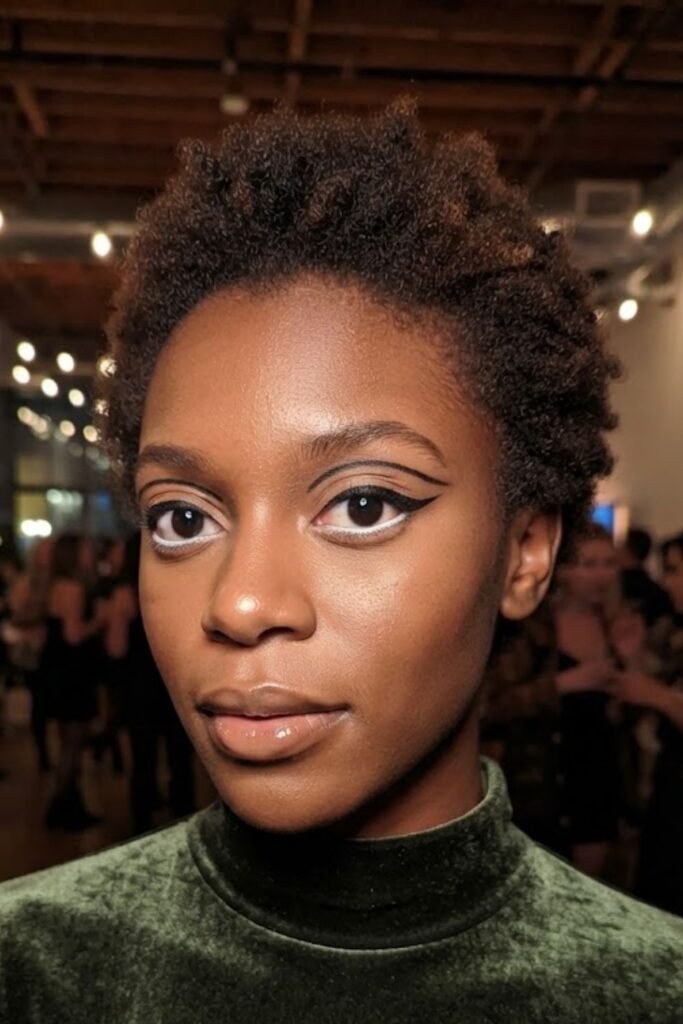
Black Floating Liner with White Lower Waterline
A floating liner look where a precise black gel liner is applied three to five millimetres above the natural lash line, leaving a gap of bare skin between the liner and the lashes, with the lower waterline filled in with a bright white pencil, creates a Halloween makeup look that reads as distinctly unusual and modern rather than traditionally spooky. The white waterline makes the eye read as larger and more widely open than usual, creating an uncanny, slightly wide quality that reads as Halloween-appropriate without any character reference.
The floating liner requires a steady hand and a precise gel liner or felt-tip liner. Draw the line in a single continuous stroke following the curve of the lash line but elevated above it. A ruler or straight edge held against the face does not work at the curved eye area: use the natural eye crease as the reference line instead, drawing the liner just above it. The gap between the liner and the lash line should be consistent across the full length of the liner for the effect to read as intentional rather than misapplied.
Monochrome Cut Crease in Black and White
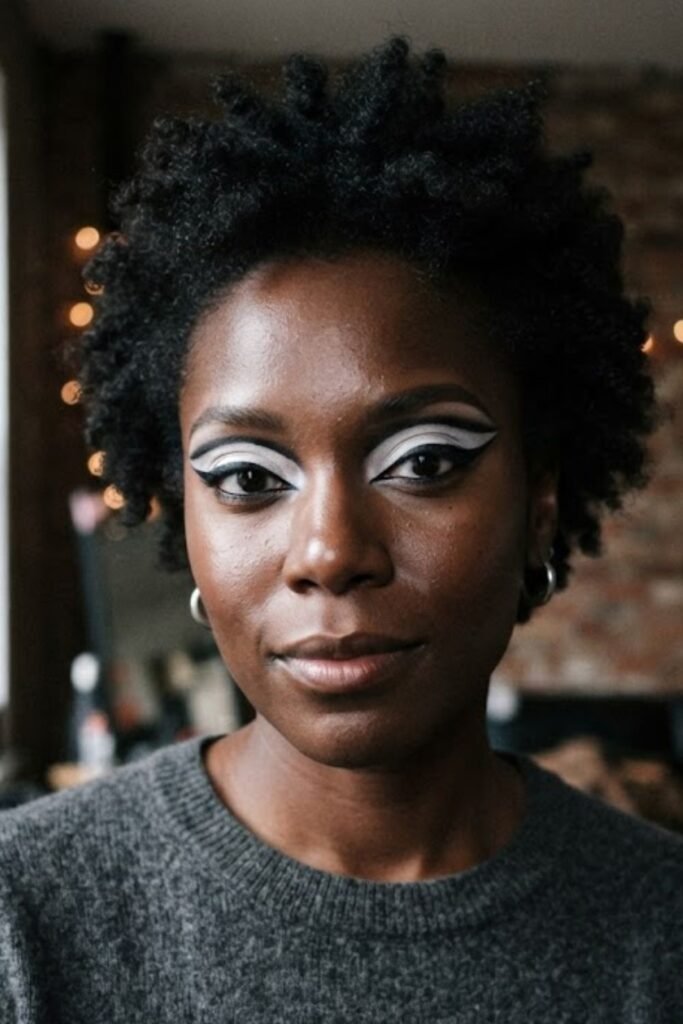
A cut crease eye using white shadow on the lid and a dense black shadow above the crease, with the dividing line between the two tones cut as precisely as possible using a thin concealer brush, creates a dramatic but wearable black and white Halloween eye that reads as a deliberate makeup technique. The precision of the cut crease line is the entire quality of this look: a clean, sharp line between white and black reads as intentional and skilled. A soft or blurred line reads as imprecision rather than blending. Valentine makeup looks cover cut crease technique in detail, with the concealer brush method and the powder setting step that keeps the crease line clean through a long event, directly applicable to achieving a precise monochrome Halloween cut crease.
Set the white lid shadow with a white setting powder before building the black above the crease, so the black shadow cannot fall onto and contaminate the white below. Pack the black shadow densely rather than blending it into the crease for maximum contrast. A matte white shadow produces a sharper visual contrast against the matte black than a shimmery white, which diffuses the light at the edge and softens the crease line.
Character-Adjacent Black and White Makeup Looks
Geometric Face Paint Look
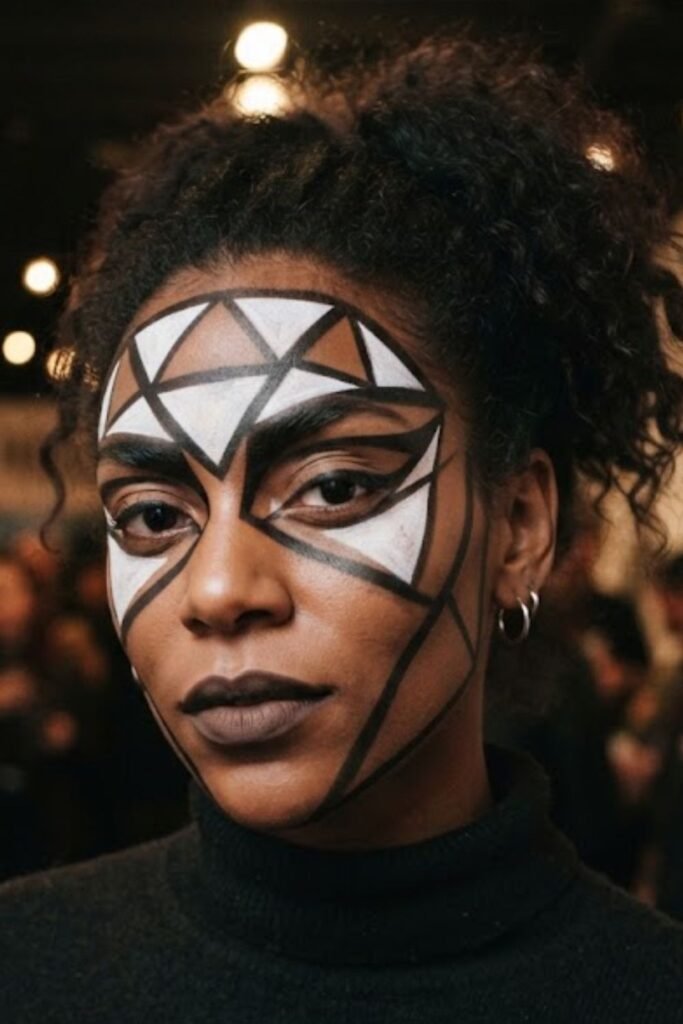
A geometric face paint look uses black and white face paint applied in precise angular shapes, triangles, diamonds, and straight lines, across the face in a pattern that reads as intentional art rather than a character reference.
One half of the face might be divided into a grid of small white squares bordered by thin black lines. The other half might be left natural or foundation-covered. The result reads as theatrical and fashion-forward rather than costumed, and it suits creative Halloween events, art-themed parties, and any occasion where the makeup itself is the costume.
Use face paint rather than regular makeup products for any large-area white or black application on the skin. Face paint is formulated to sit on the skin surface without sinking into pores or transferring, which regular white foundation and black eyeshadow are not designed for at this coverage level.
Edgy boho outfit ideas in dark tones pair with a geometric face paint look at the same art-forward, dark aesthetic register, and lace skirt outfits in black or white provide the outfit context where the graphic geometric face paint reads as a complete, considered look from face to hem.
Classic Skeleton Face
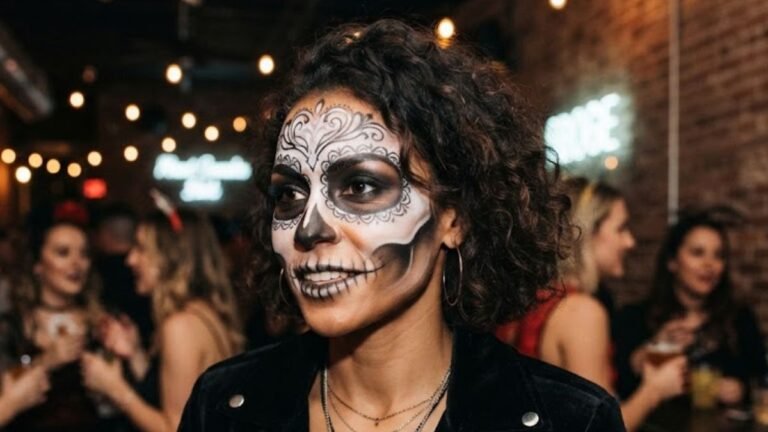
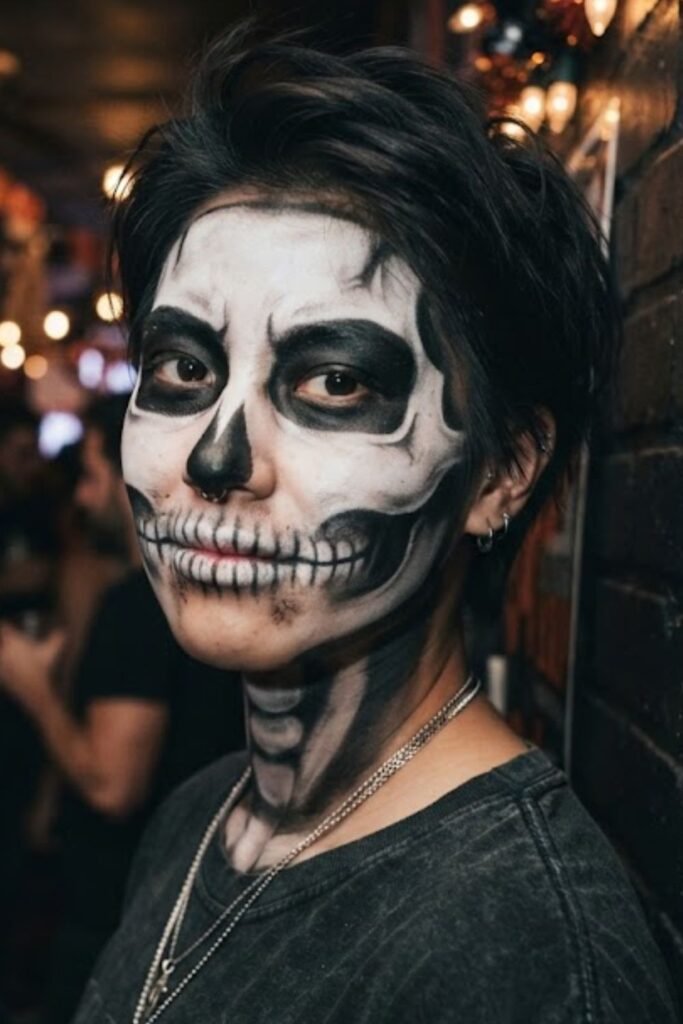
The skeleton face is the most recognizable black and white Halloween makeup look and also the most technically demanding to execute well: the bone structure of the skull, the elongated nose cavity, the cheekbone shadows, and the jaw line definition each require both anatomical reference and makeup technique to look deliberate rather than approximately applied. A skeleton face executed with precision reads as a complete costume. A skeleton face executed without anatomical consideration reads as face paint.
Begin with a full-coverage white face paint base applied from hairline to jaw and blended to the neck. Allow to set and powder before any black work. Use a fine brush and black face paint rather than eyeshadow for the shadow areas: the black should sit on the skin surface without sinking in or spreading beyond the intended edge.
The nose cavity is drawn as a heart or inverted triangle shape centered over the nose. The cheekbone shadows are painted along the hollow below the actual cheekbone to read as the orbital depression of a skull. Thin black lines drawn along the natural lip line and extended slightly outward create the teeth illusion on the lips.
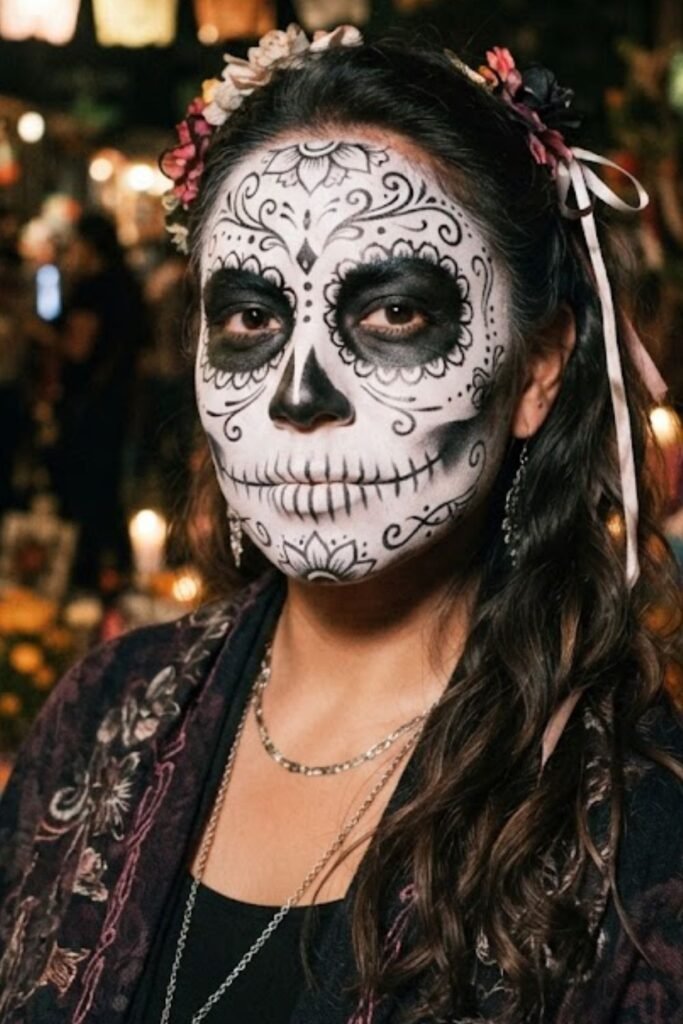
Sugar Skull in Monochrome
A sugar skull makeup look executed entirely in black and white, without the traditional vivid color palette, reads as a more sophisticated and graphic version of the Dia de los Muertos aesthetic. The floral patterns, the ornamental eye surrounds, and the decorative elements that characterize sugar skull makeup all retain their visual complexity in monochrome, but the absence of color shifts the register from celebratory to gothic.
Start with a full white face paint base. Draw the large eye surrounds in black face paint as perfectly circular as possible using a round template or careful freehand. Add floral designs, teardrop shapes, and ornamental patterns within and around the eye surround using a fine brush.
The web or floral pattern on the forehead should be symmetrical across both sides of the center line. Masquerade hairstyles include dramatic face and eye decoration at masquerade and theatrical occasion levels that show how ornate facial art reads alongside elaborately styled hair under event lighting, directly relevant for planning the full look around a monochrome sugar skull.
Cracked Porcelain Doll
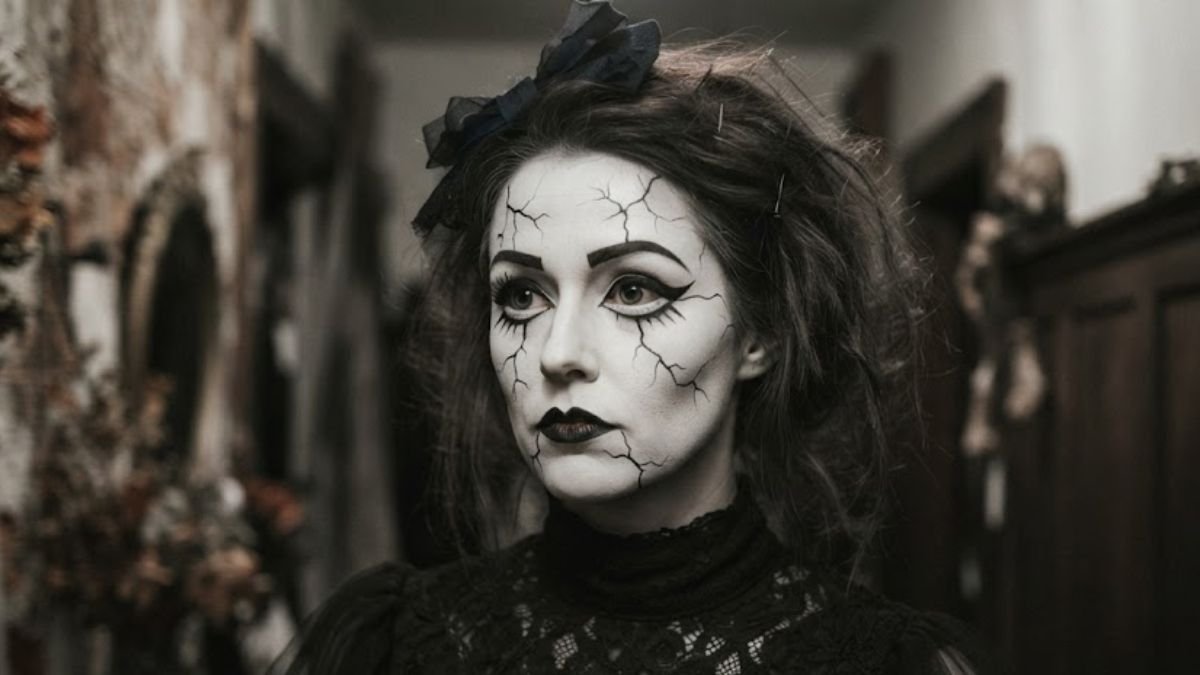
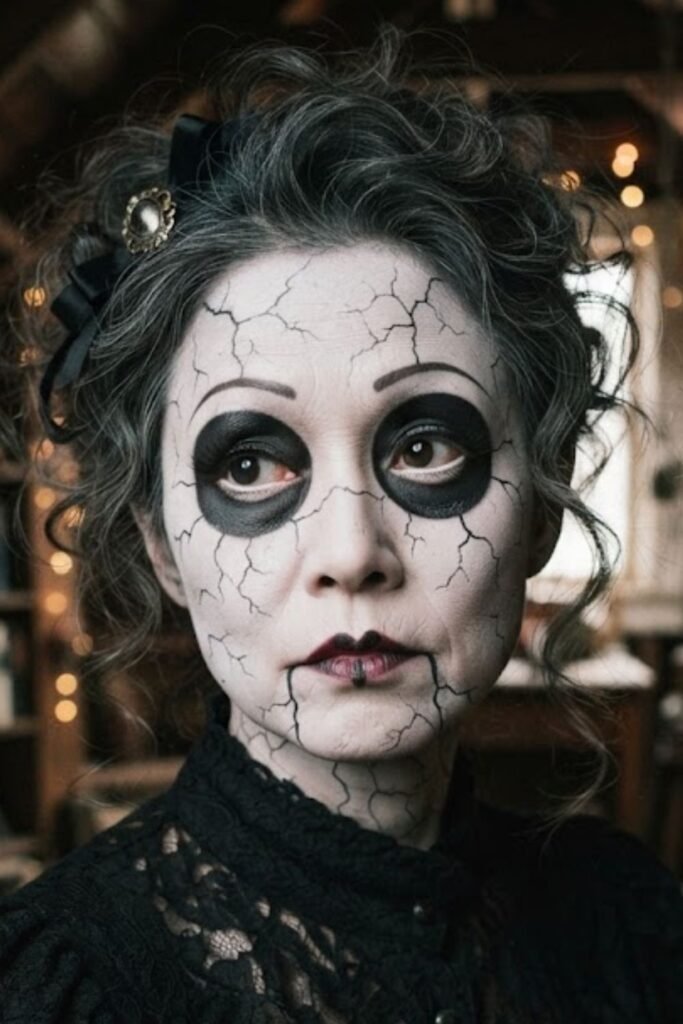
A cracked porcelain doll makeup look creates the illusion of a ceramic face with hairline cracks running from the eyes or forehead.
The look is achieved with a pale foundation base, fine black liner drawn in irregular, branching crack lines from a central point, and dark grey shadow shaded on one side of each crack line to create the illusion of depth below the crack.
The overall effect reads as uncanny and unsettling in the way that the porcelain doll character aesthetic operates at Halloween.
The crack lines should be drawn in a pattern that follows the natural movement points of the face, from the outer corner of the eye, from the temple, or from the forehead center, so they read as stress lines at the points where a ceramic face would actually fracture.
Cracks that run across static areas of the face rather than from natural stress points read as decorative rather than realistic. The depth shading, a thin grey shadow applied to one side of each crack line, is what distinguishes a realistic-reading cracked porcelain look from a flat pattern of black lines on white skin.
Theatrical Black and White Makeup Looks
Full White Face with Graphic Black Eye Mask
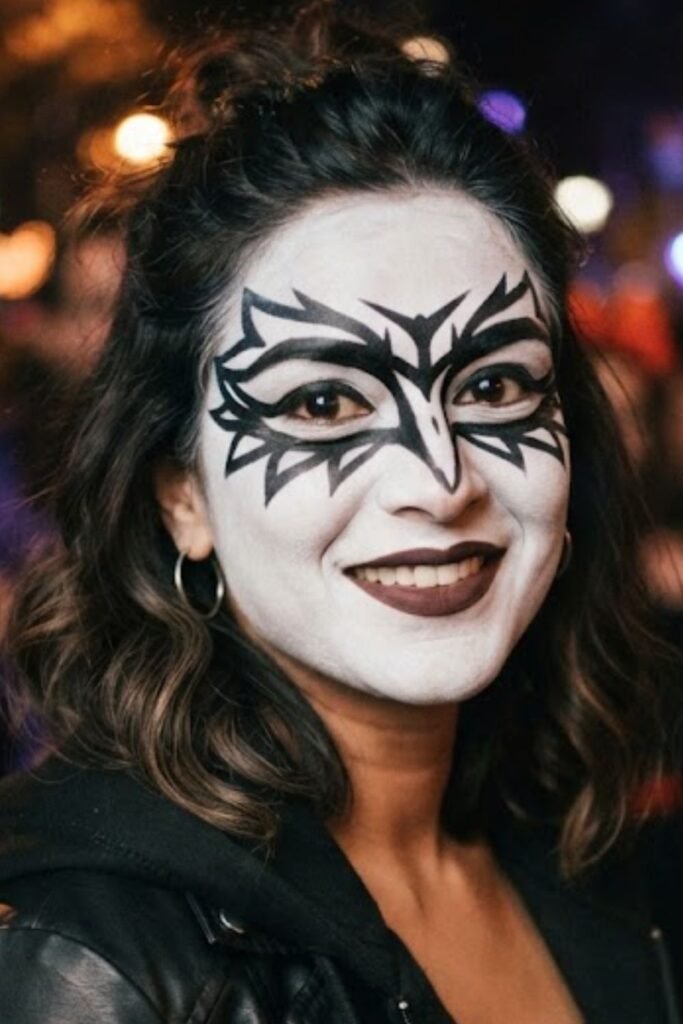
A full white face paint base with a graphic black mask design painted around the eye area in the style of an elaborate masquerade mask, complete with ornamental swirls, pointed upper edges, and decorative elements extending toward the temples, is the Halloween makeup look that reads as the most formally theatrical.
The design functions as both a mask and a makeup look simultaneously: the ornamental eye surround reads as a physical mask from a distance and as elaborate face paint up close. Masquerade hairstyles include elaborate masquerade-level costume and accessory choices that show how a painted mask reads alongside masquerade hairstyles and accessories at a formal Halloween occasion.
Apply the full white face paint base first and allow to set and powder before beginning any black work. The black mask design should be planned on paper before applying to the face: sketch the symmetrical mask shape including where the decorative elements extend toward the temples so you can mirror the design on both sides. Use a fine brush and black face paint for all line work. Fill the mask area densely with black face paint for a fully opaque mask effect rather than a transparent shadow.
Half-Face Skull
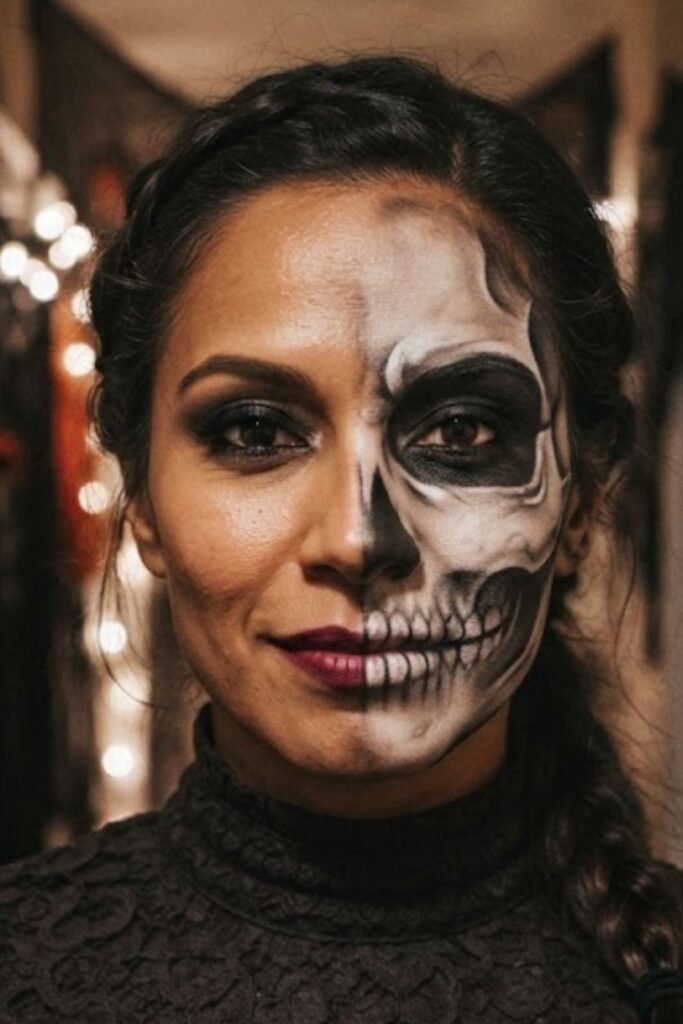
A half-face skull look, where one half of the face wears normal foundation and makeup while the other half is transformed into a skull using white face paint, black shadow hollows, and bone line detail, creates the most visually striking of the theatrical black and white looks because the direct side-by-side contrast between the natural face and the skull reads as more unsettling than a full skull on its own.
The line dividing the two halves runs vertically from hairline to jaw through the center of the nose.
The natural makeup half should be styled to read as deliberately beautiful and finished, with clean foundation, defined brows, and a well-applied eye look. The contrast between the polished natural half and the skull half is what makes the look read as intentional and theatrical rather than a costume.
Apply the white face paint on the skull half with a sponge to achieve the solid coverage that a brush cannot. Shade the hollow eye socket with black shadow pressed close to the orbital bone. The most impactful detail is where the natural lip color on the natural half meets the skeletal lip line on the skull half at the center of the mouth.
Abstract Black and White Body Art Extending to the Face
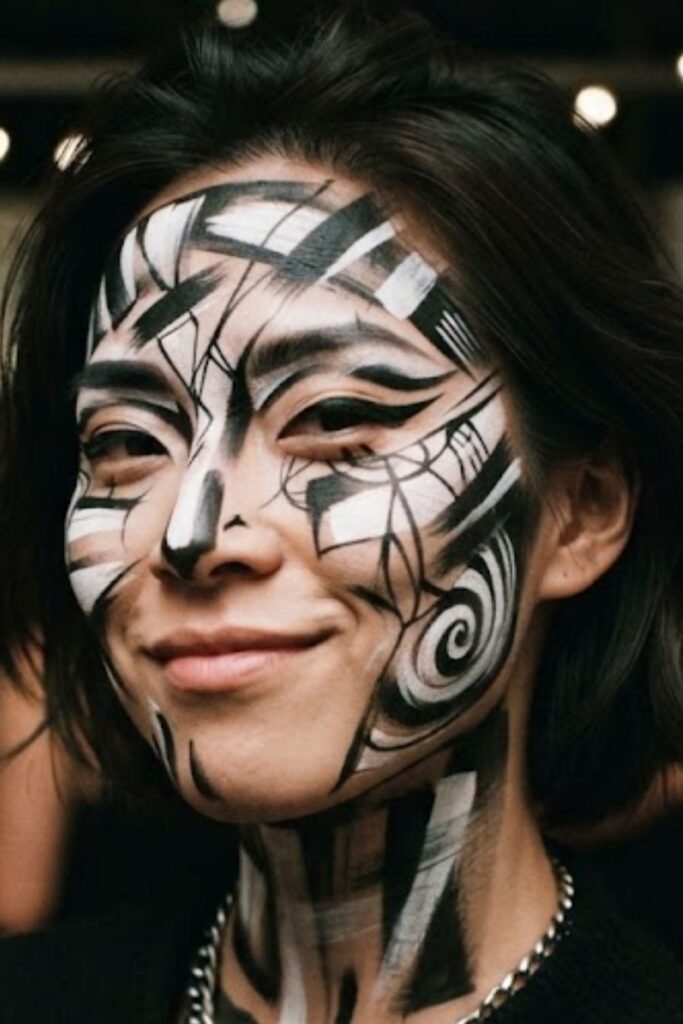
An abstract black and white body art look where sweeping graphic shapes, large black organic forms, thin white lines, and soft grey shadow tones, flow from the neck and décolletage upward onto the face and create a complete body art composition, is the most ambitious and genuinely artistic of the ten looks on this list.
The design reads as wearable art rather than Halloween costume, and it suits gallery openings, art-themed events, and any Halloween occasion where the makeup is the full creative statement. Goddess nail designs and ombre nail ideas in black and white tones complete the full body art look from face to fingertips, where the nail palette and texture choices can extend the same monochrome graphic language across the full visible surface.
The body art should be designed as a complete composition before any product is applied, sketched on paper to plan how the forms flow from the body upward across the jaw and into the face.
The transition point where the design moves from the neck onto the face is the most technically challenging: the skin texture changes at this boundary and the face paint behaves differently on the more mobile face skin than on the neck and décolletage.
Use a setting spray over the completed body art to minimize transfer onto costume and clothing throughout the evening.
Products and Techniques for Black and White Halloween Makeup
The White Base Is the Most Important Step
Every look on this list that uses a white base, looks four through ten, depends on that base being fully opaque, smooth, and set before any black work is applied.
An unset white base smears into the black applications, a grey smudge rather than a clean black design. A textured or uneven white base makes every line drawn over it look uneven by association. Apply the white in thin layers using a damp sponge rather than a single thick application.
Allow each layer to dry before the next. Dust with a translucent or white setting powder before any black work. That sequence is non-negotiable for any look in this category.
Use Face Paint for Large Coverage Areas
Black and white eyeshadow, eyeliner, and regular foundation are the right products for the eye-based looks on this list, where the coverage area is small and the product is within its intended use range. For any look that requires covering significant portions of the face or body in a solid white or black, face paint formulated for skin coverage is the correct product.
Regular foundation cannot achieve the opacity that white face paint achieves. Black eyeshadow cannot hold its depth over large skin areas the way black face paint does. The right product for each area of the look determines whether the overall result reads as polished or approximate.
Setting Spray Is the Difference Between Lasting and Not
Black and white face paint applied without setting spray transfers onto costumes, onto other people, and onto anything the face touches during an active Halloween evening.
Two light coats of a makeup setting spray, the first applied immediately after powdering and before any black work, and the second over the completed look before leaving the house, significantly extends the wearability of any look that uses face paint.
Allow each coat of setting spray to dry fully before applying the next. Pressing a tissue against the face after applying setting spray removes excess without disturbing the makeup underneath.
Frequently Asked Questions
What products do I need for black and white Halloween makeup?
For the minimal looks using standard makeup products: a white or very pale foundation, white eyeshadow or face paint for specific applications, matte black eyeshadow, black gel liner or felt-tip liner, white eyeliner pencil for the waterline, and a strong setting powder and setting spray.
For the face paint looks: white face paint formulated for skin, black face paint, a damp makeup sponge for base application, a medium flat brush for filling large areas, and a fine-tipped brush for line work and detail. Both product sets require a good setting spray as a final step.
How do I remove black and white Halloween face paint?
Oil-based makeup remover or micellar water on a cotton pad removes most face paint without requiring scrubbing, which can irritate the skin and spread the pigment further across the face. Start at the outer edges of the design and work inward so you are removing the pigment toward the center rather than spreading it outward.
For stubborn black pigment, hold an oil-soaked cotton pad against the area for thirty seconds before wiping rather than rubbing immediately. A second cleanse with a gentle foam cleanser after the face paint is removed ensures no product residue remains.
Can I do any of these looks without face paint?
Looks one through three are achievable entirely with standard makeup products: regular foundation, white eyeshadow, black eyeshadow, and precise eyeliner. The cracked porcelain look, look seven, is achievable with a pale foundation base and fine black eyeliner rather than face paint, though the base will not be as uniformly white. Looks four through six and eight through ten all require face paint for the white base to achieve the opacity the design depends on. Attempting those looks with regular foundation rather than face paint produces a visibly different result.
How long does black and white Halloween makeup take to apply?
The minimal looks, the graphic black eye and the floating liner, take twenty to thirty minutes including the pale base. The cut crease takes thirty to forty minutes for a clean crease line. The geometric face paint and the half-face skull each take forty-five to sixty minutes.
The classic skeleton, the sugar skull, and the full white face mask each take sixty to ninety minutes. The cracked porcelain takes forty-five to sixty minutes. The abstract body art takes ninety minutes or more depending on the complexity of the composition and the coverage area. All estimates assume the products and tools are prepared and within arm’s reach before starting.
What Halloween hairstyle suits black and white makeup best?
For the minimal makeup looks, any hairstyle suits because the makeup is subtle enough that the hair and the makeup are not competing. For the character-specific looks, the hairstyle should either reference the same character or remain neutral so it does not dilute the makeup’s character signal.
For the theatrical face paint looks, a sleek updo or a simple down style keeps the hair from competing with the face as the visual focal point. Elaborate hairstyles alongside full face paint reads as two separate statements rather than one complete look.
Final Thoughts
Black and white Halloween makeup works because it commits to a single decision. The absence of color is a choice, and when it is made deliberately, with the right products in the right sequence and with enough precision in the application, it reads as a stronger costume statement than a face full of ten different colors applied without the same care. The ten looks here cover the range from a graphic eye that takes twenty minutes to an abstract body art composition that takes ninety. Choose the level that suits your skill, your time, and the specific Halloween occasion. Aura effect nail ideas in black and white tones and french nails ideas in a black base and white tip finish are the nail pairings that extend the monochrome Halloween aesthetic from the face to the hands most cohesively.